What is a positive 16k, and how big is a generous 16k?
Positive degree 16 open (185*260)
Generous 16 open (210*285)
What unit is "open"?
Open as many sheets of paper as you can open.
For example: 16K means 16 cards will be opened in full, and 2 cards will be opened in the opposite direction.
How old is it?
Full opening degree: 780 *1080
Generosity: 880 *1180
The so-called opening of the printing paper specification means that the number of openings is cut into several copies. For example, an 8 opening paper is 1/8 of the full opening (three cuts in half). The paper size must be selected before designing, because the printing machine can only use a few kinds of paper (usually full-open, full-open), and then use the machine to cut into the required size after printing once, so don’t use the following table if you have nothing to do. Other special specifications, so as not to waste the layout due to dissatisfaction of the paper printing.
Because the machine has to pick up and feed the paper, the edge of the paper cannot be printed. Therefore, the original size of the paper will be larger than the actual size. Wait until the printing is completed and then cut off the marginal part, so that the whole The difference between the size and the cut size. If the poster intentionally leaves white borders, you can also choose not to cut it.
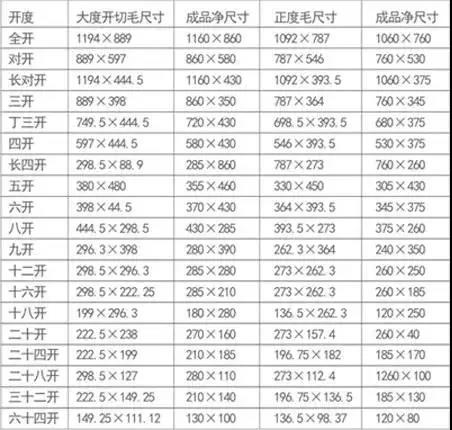
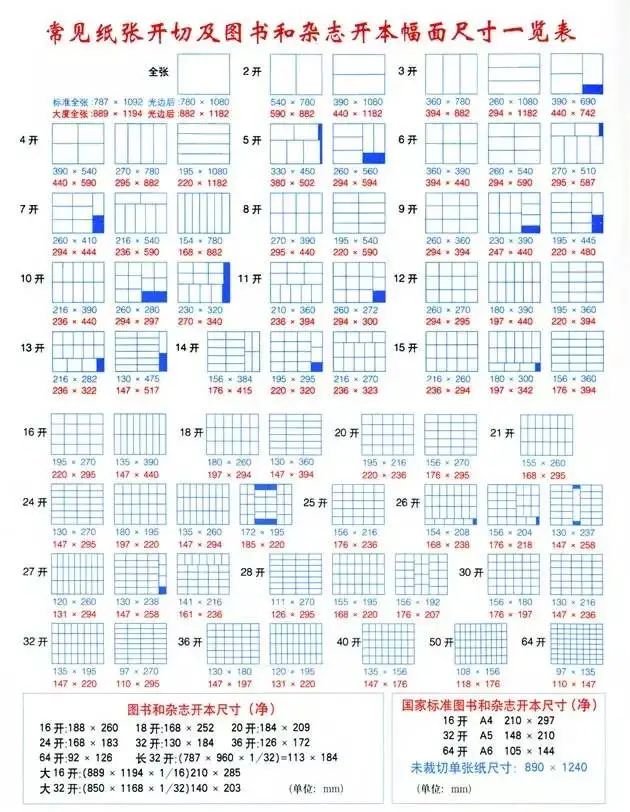
There are four most common specifications for paper
① Positive paper: 109.2 cm long and 78.7 cm wide
② Generous paper: 119.4 cm long and 88.9 cm wide
③ Sticker: 765 cm long and 535 cm wide
④ Non-carbon paper: There are positive and generous specifications, But there are different paper prices
The most common names of paper
① Copy paper: 17g positive specification, used for value-added tax invoices, gift packaging, generally pure white.
② Typing paper: 28g positive specification, used for joint orders and forms, in seven colors: white, red, yellow, blue, green, light green, and purple.
③ Glossy paper: 35-40g positive specification, one side glossy, used for coupons, forms, memos, low-grade printing paper.
④ Writing paper: 50-100g generous, both positive, used for low-end printed matter, most of which are domestic paper.
⑤ Double offset paper: 60-180g generous, both positive, used for mid-range prints are common in domestic, joint ventures and imports.
⑥ Newsprint: 55-60g roller paper, positive paper, newspaper selection.
⑦ Carbon-free paper: 40-150g generous, all positive, with direct copy function, divided into upper, middle and lower paper. The upper, middle and lower paper cannot be exchanged or turned over. The paper price is different. There are seven colors, which are commonly used. Coupon, form.
⑧ Coated paper:
Double copper 80-400g: both positive and generous, used for high-end printing.
Single copper: used for medium and high-end printing such as cartons, cartons, hand bags, medicine boxes, etc.
⑨ Sub-flour paper: 105-400g for elegant, high-end color printing.
⑩ White paper with gray background: more than 200g, with gray on white background, used for packaging.
⑪ White cardboard: 200g, double-sided white, used for mid-range packaging.
⑫ Kraft paper: 60-200g, used for packaging, cartons, document bags, archive bags, and envelopes.
⑬ Special paper: Imported paper is commonly used, mainly used for printing covers, decorations, handicrafts, fine products, etc.
Newsprint
Newsprint size: 547mm*392mm, 545mm*370mm.
Common newsprint has the following specifications
It should be noted here that there are generally two open methods for paper-two open methods and three open methods.
The two-opening method is to fold the paper into two at a time, so the open number is also increased by the power of two.
The three-opening method is relatively more complicated. The first knife cuts the paper into three, so the number of openings is increased by a multiple of 3.
In addition, there are some special opening methods according to special needs.
Paper produced by paper mills generally has two forms: 1. web paper and 2. flat paper .
web
The roll paper is in the form of a roll, and the volume is very large. The weight of each roll is calculated in tons. They are used on the rotary printing machine (the toilet paper sold in the supermarket also has a roll type, also called roll paper. It's the same), the width of the roll paper has multiple specifications, and the length is not limited (in fact, it is limited, but each roll of paper is very long). The printing of newspapers is mostly on roll paper, which is fast and efficient. .
Flat paper
Flat paper is used on a flatbed printing machine. It is a single sheet. There are also several specifications for flat paper, which are divided into "positive" and "large" (the previous standard specification was 787*1092mm, and later books became bigger and bigger. , The original specification paper is not applicable, paper mills have produced larger specifications of paper, the society is used to call the 787*1092 specification paper as positive, which means "standard", and the ones that exceed the positive are collectively referred to as magnanimity) .
format
The uncut flat paper supplied from the paper mill is called "full sheet" or "raw sheet" or "full open paper".
When you cut a whole sheet of paper into several equal parts, it is called “different”. For example, if you divide a whole sheet of paper into 16 pieces, it means 16 karats. If you divide it into 2 parts, it means 2 folds, which is also called folio. 8 servings is 8 open, and so on.
The paper opening method includes the front opening method, the horizontal opening method and the deformed opening method. The cutting edge parallel to the long side is the horizontal opening method, and the short side is parallel to the front opening method.
Printed sheet
"Printed sheet" is a very important calculation concept and unit. In lithographic printing, how many "sheets" of paper does a book use, how many reams of paper I need to buy for printing, are all related to the printed sheet. , If you don’t know how to print, you can’t calculate the cost.
"Printed sheets" means "number of sheets of printing paper" or "number of sheets used for printing", which actually refers to "quantity of paper used for printing".
So what is the size and unit of "sheet" in "number of sheets"? How many "sheets" of paper does it take to print a book?
"Number of printed sheets" is based on the size of a folio, so: a folio is a printed sheet, that is, a folio=1 printed sheet, then a full-open paper=2 folios, so a full-open is 2 printed sheets, and 4 The opening is half of the folio, so 4 openings are 0.5 printed sheets, 8 openings is 14 openings, which is 0.25 printed sheets, 16 openings is 0.125 printed sheets, 32 openings is 0.0625 printed sheets, and so on.
You can simplify it to: printed sheet = page format.
There are two pages per page, one page is a page number, then how many prints is a large 64-open note=264=0.03125 prints, then how many prints is a large 64-open 100-page note=100 (pages)*2 (Page) ÷ 64 (format) = 3.125 printed sheets, or directly 100 pages * 0.03125 printed sheets = 3.125 printed sheets.
The customer wants to print 5000 copies of the same note=5000*3.125=15625 sheets, that is, 15625 large folio sheets are needed. If the number of printing and binding is not calculated, the actual need is 15625÷2=7812.5 sheets of generously opened sheets.
make
"Ling" is a unit of quantity. It refers to "500 sheets of paper", which means that 500 sheets of paper are only one order. Then 1 order = 1000 opposites = 4 2000s = 8 4000s = 16 Open 8000 tickets.
Some people don't talk about opening numbers, thinking that as long as it is 500 sheets, it is 1 ream. This is absolutely wrong.
Although the original sheet of self-adhesive paper supplied to us by the manufacturer is 765*535mm, it belongs to the facing size in printing, so 500 stickers of this size are only counted as half orders.
How many reams of paper are needed to print 5000 copies of 100-page large 64-size notes in the "print sheet" above?
The number is calculated by 2%, that is 15625*1.02÷1000=15.94 order.
proportion
"Specific gravity" here means "gram weight", which is the weight of 1 square meter of paper.
We often hear customer requests saying "I want 60 grams of writing paper", "I want 80 grams of double offset paper", "I want 200 grams of coated paper", "I want 250 grams of gray-bottomed white paper" and so on. Number and variety of paper.
Paper is divided into many grams and varieties. The same type of paper has different grams, their thickness is different, and the printing performance is also different, let alone different varieties.
There are so many varieties of paper, but there are not many commonly used ones. Just learn more about it in future practice.